
 By Ryan White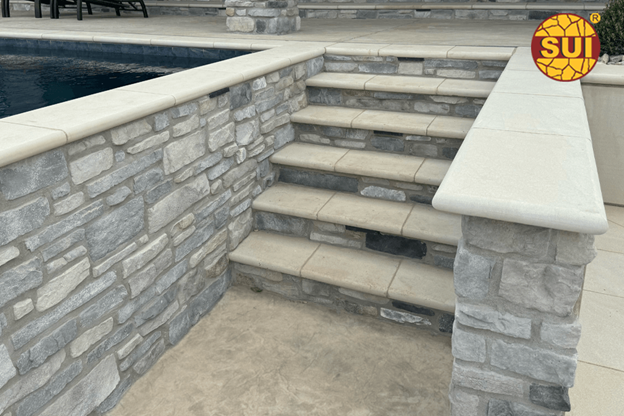
Saltwater systems cause rapid oxidation in traditional pool finishes, leading to pitting and structural failure.Bullnose finishes outperform others in 2026 because their rounded, seamless profile eliminates sharp edges where salt crystals accumulate. This aerodynamic geometry reduces chemical dwelling and moisture retention, significantly extending the lifespan of the pool’s perimeter.
The transition from traditional chlorine-based filtration to saltwater chlorination has redefined the requirements for hardscaping materials. In the B2B sector, spanning luxury hospitality, multi-family residential developments, and commercial aquatic centers, saltwater systems are preferred for their lower operating costs and enhanced user experience. However, these systems introduce a highly corrosive environment that can compromise the integrity of the pool deck and coping.
Corrosion in a pool setting is not limited to metal components. Natural stone and masonry products are also susceptible to chemical degradation when exposed to constant wetting and drying cycles. In saltwater pools:
- The process of electrolysis and the presence of sodium chloride can accelerate the breakdown of calcium-based stones or poorly finished surfaces.
- For B2B stakeholders, the cost of replacing coping every five years is prohibitive.
- The selection of a finish that minimizes stress points is essential.
- A sharp, 90-degree edge on a pool perimeter acts as a collection point for minerals.
- The concentrated salt degrades the sealant and eventually the stone itself.
The bullnose profile is characterized by its smooth, hemispherical edge. While often chosen for its soft look, its performance in a saltwater environment is backed by physical principles that outperform square, mitered, or drop-face edges.
The primary enemy of any pool coping is standing water. When water splashes onto a flat or sharp-edged surface, surface tension often holds droplets at the very edge. As the sun evaporates the water, the salt remains. By reducing the time salt water spends in contact with the stone, the rate of corrosion is drastically lowered.
In material science, sharp corners are known as stress concentrators. This applies to both physical impact and chemical weathering. In a commercial environment with high foot traffic, sharp edges are prone to chipping.
Once a chip occurs, the protective sealant is compromised, and salt water can penetrate the core of the material. Bullnose coping distributes physical pressure and chemical exposure across a curved surface, ensuring that no single point bears the brunt of the environmental load.
Modern manufacturing of bullnose finishes involves advanced calibration. Because the edge is rounded, the material must be of a consistent density to maintain its shape during the machining process. This results in a product that is often more resilient than standard pavers.
In 2026, the preference for natural stone in B2B projects remains high due to its prestige and inherent durability. However, not all stones are created equal when paired with a saltwater system. Selecting the right material to be finished with a bullnose edge is the second half of the durability equation.
Travertine and limestone remain staples in the market for their thermal properties. In a bullnose finish, these materials offer a slip-resistant surface that stays cool under the sun. When properly sealed, the rounded edges of travertine prevent the honeycomb pitting that can sometimes occur when salt is trapped in the stone’s natural pores.
For high-traffic commercial plazas and resort pools, sandstone and quartzite offer incredible compressive strength. When shaped into a bullnose coping profile, these stones become nearly impenetrable to the corrosive effects of salt.
For developers and property managers, the choice of pool finishes involves more than just chemistry; it involves risk management.
In commercial settings, the softness of the pool edge is a safety requirement. A bullnose edge reduces the risk of abrasions or cuts if a swimmer bumps into the side of the pool.
Labor costs for specialized masonry cleaning are rising. Square-edged coping often requires manual scrubbing to remove salt crusting that accumulates in the joints and edges. The streamlined nature of a rounded finish allows for easier power washing and more effective sealing.
Trends in 2026 lean toward organic modernism, a style that favors soft curves and natural textures. A rounded finish aligns with this trend, ensuring the property remains visually relevant.
The versatility of the rounded edge allows it to be integrated into various architectural styles. It is not limited to the pool’s immediate edge. Architects are increasingly using these finishes for:
- Step Treads: Ensuring continuity of design and safety throughout the aquatic area.
- Wall Caps: Protecting raised planters and retaining walls from the overspray of saltwater.
- Benches and Seating: Providing comfortable, snag-free seating for guests within the pool environment.
When specifying materials for a US-based commercial project, it is essential to look at the ASTM (American Society for Testing and Materials) standards for water absorption and compressive strength. A high-quality stone with a low absorption rate, finished with a precise radius, provides the ultimate defense.
Professionals should ensure that the stone thickness is consistent, typically 1.25 to 2 inches for commercial coping to handle the weight and activity of a public or semi-public pool.
The evolution of outdoor living and commercial aquatic design has made the durability of materials a top priority. As saltwater systems become the standard for modern pools, the mechanical advantages of rounded masonry cannot be overlooked. The ability to shed water efficiently, resist physical chipping, and provide a safer environment makes this finish the superior choice for B2B applications.
Stone Universe Inc. stands as a premier wholesale distributor of high-quality natural stone, offering an extensive range of bullnose products designed to meet the rigorous demands of commercial and residential projects. Their commitment to sourcing durable, aesthetically superior materials ensures that every development achieves both lasting structural integrity and timeless visual appeal.